The exit sign that points into the dead end
The arrow is a direction. Reviewers follow it.
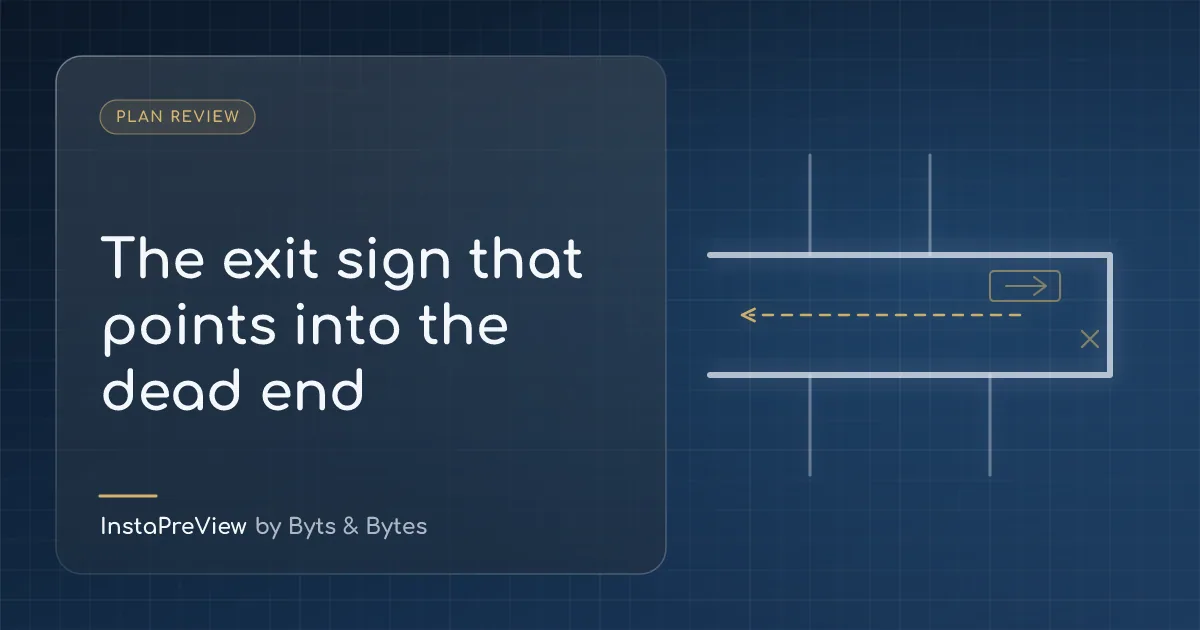
Exit signs are not decoration. An arrow at the end of a corridor tells an occupant who does not know the building which way to walk. If that arrow points at a closed end, the sign is sending people into the dead end you were supposed to keep short.
Two different rules are in play, and reviewers write both.
The sign itself is the exit-sign section the exit sign guide covers, titled there as IBC 1013. Confirm the section number in the edition the city adopted. The model 2021 chapter is Chapter 10. Placement, visibility, and which doors get a sign are that guide. This post is the arrow that points the wrong way.
The dead end is Section 1020.5 in the 2021 IBC: 20 feet where more than one exit is required, with a 50-foot exception only for listed occupancies in a building sprinklered under Section 903.3.1.1. The dead-end guide has the exceptions, including the one for a wide pocket whose length is less than 2.5 times its least width. ICC staff interpretation BU_21_68_23 says an intervening door that does not swing with egress, and that has no exit sign, can be used to break a dead end, with each segment still inside the limit. That is a staff interpretation, not a code change, and the absence of the sign is part of the reasoning. Putting a sign on that door undoes the idea.
Walk the plan the way a stranger would. From the sign, follow the arrow. You should reach an exit, or a point where two signs offer two ways out, without turning into a closet corridor. If the only sign a person sees from the elevator points past the stair to the end of the hall, move the sign. Do not add a second sign that contradicts the first.
The mistake is copying a sign family onto every door because the family was in the template. Doors that are not exits do not get exit signs. Doors that are exits get signs people can see before they have committed to the wrong leg of the corridor.
Confirm the edition on the jurisdictions page, then upload the life-safety plan and run a free scan. Wayfinding comments are visible on the plan if you follow the arrows once before the reviewer does.
This is advisory. It is not a determination by the authority having jurisdiction. Confirm the adopted edition and local amendments before you change a drawing.